





Sanitation services
17 June 2026
High-pressure cleaning and in-situ treatment: a 2-in-1 solution for this polluted stormwater basin

At an industrial scrap and metal recycling facility near Bourges, a stormwater retention basin that had been left unmaintained for several years had accumulated nearly 400 m³ of sludge contaminated with lead, hydrocarbons, and heavy metals. To tackle this challenge, which involved both remediation and decontamination, the Séché Environnement Group mobilized two of its complementary subsidiaries: Séché Assainissement and Séché Eco Services.
A Storm Water Retention Basin Out of Service, Compliance at Stake
Our client operates a large industrial site specializing in the recovery, recycling, and shredding of scrap metal and other metals. Like all sites of this type, stormwater is collected, temporarily stored, and treated before being discharged into the natural environment. This is precisely the role of the stormwater retention basin: a retention structure that acts as a buffer between the site’s water and the treatment plant, particularly during heavy rainfall events.
To function properly, this type of structure must be maintained regularly; however, at this site—recently acquired by our client—the basin had not been dredged for several years. As a result, gradual sedimentation had led to the accumulation of a considerable volume of sludge at the bottom of the structure, gradually rendering it inoperative.
The challenges were threefold:
- functional: a clogged basin can no longer store the necessary volumes of water during peak rainfall events, which compromises the proper functioning of the entire treatment chain ;
- environmental and regulatory: the accumulated sludge, heavily laden with pollutants, posed a direct risk to the quality of the water passing through the facility ;
- structural: excessive sediment buildup can damage the basin’s waterproofing membrane, resulting in repair costs far higher than those of regular preventive maintenance.
On-site Remediation and Treatment: A Tailored Synergy Between Two of the Group’s Areas of Expertise
Given the scale of the project and the specific nature of the sludge—contaminated with lead, hydrocarbons, and heavy metals—it was out of the question to limit the operation to simply pumping the sludge and hauling it away in tanker trucks. Such an approach would have required about twenty truck trips to remove 400 m³ of liquid sludge, not to mention the costs of outsourced treatment.
The Séché Environnement Group’s solution therefore relied on the simultaneous mobilization of two subsidiaries with complementary expertise: Séché Assainissement, an expert in hydro-cleaning and industrial cleaning operations, and Séché Eco Services, a specialist in mobile industrial wastewater treatment facilities and contaminated sludge management. Together, they deployed a complete treatment line directly at the client’s site.
Step 1 — Sludge Pumping
The process begins with pumping the sludge that has settled at the bottom of the basin. Once most of the volume has been removed, Séché Assainissement’s hydro-cleaning trucks take over; they suck up the remaining sludge and transport it to the treatment line. This is the core of the industrial sanitation business: deploying the right equipment to extract the sludge without damaging the structure.
Step 2 — Screening
As it exits the pumps, the sludge passes through a rotary trommel—a rotating mechanical screen that captures all large foreign objects—such as pieces of scrap metal, plastic, wood, and rocks—that could damage downstream equipment.
Step 3 — Flocculation
The screened sludge is then kept in agitation in sealed tanks where a flocculant (polymer) is added. This chemical reagent causes the fine suspended particles to aggregate, forming heavier “flocs” that naturally settle to the bottom. This solid-liquid separation is a prerequisite for effective dewatering in the filter press. The water is then directed to the site’s separator and subsequently to the site’s treatment plant.
Step 4 — Filter Press
The filter press, the true heart of the Séché Eco Services system, mechanically compresses the flocculated sludge to extract as much water as possible. At the inlet, the sludge contains approximately 90% water. After passing through the filter press, the result is dehydrated sludge “cakes” containing little more than 30% residual water. The filtered water is also directed to the site’s treatment facilities. This dual benefit—a massive reduction in the volume of waste to be disposed of and the reuse of treated water—is the major advantage of on-site treatment.
Step 5 — Disposal of Dehydrated Sludge
The sludge cakes from the filter press are loaded into dumpsters for disposal. Thanks to the dewatering process, the 400 m³ of sludge was reduced to just 6 to 7 dumpsters of solid waste. Given the presence of lead, the sludge is sent to a Class 1 landfill specializing in hazardous waste.
Step 6 — High-Pressure Cleaning of the Basin
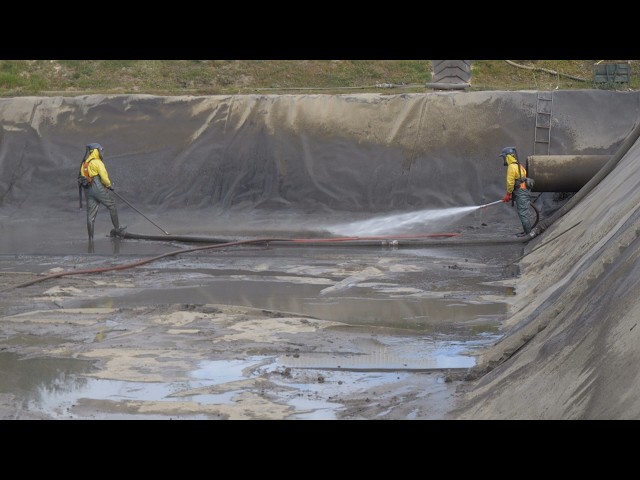
Once most of the sludge had been removed and the basin drained, the Séché Assainissement teams proceeded with high-pressure cleaning of the walls and bottom of the structure. The hydro-cleaning trucks, equipped with high-pressure units, lances, and rotating nozzles, dislodged the residual deposits encrusted on the membrane and the internal surfaces of the basin. This final step ensures that the structure is returned to the client in optimal condition, ready to resume its function of retaining and pre-treating effluent.
Lead: A Risk Not to Be Underestimated
Since analyses revealed the presence of lead in the sludge, the group’s Quality, Safety, and Environment (QSE) department paid particular attention to this project.
A preliminary site visit with the sales team and plant operators, the formalization of a risk analysis, and the development of a specific prevention plan… The methodological rigor that is standard practice at Séché Environnement ensured the safety of all personnel involved without disrupting the project schedule:
- Sensors were installed in the immediate vicinity of the site and integrated into the operators’ Personal Protective Equipment (PPE) to continuously monitor exposure levels throughout the work.
- Ventilated respirators with specific filter cartridges were made mandatory for operators working inside the basin, and only operators who had previously been trained in the use of this type of equipment were assigned to the task.
- Awareness sessions on lead-related risks and the specific operating procedures to be followed on the job site were conducted at the start of each shift.
- The transport of dewatered sludge to a hazardous waste landfill—which was not initially included in the contract—was quickly incorporated into the scope of work.
The result: a stormwater basin restored to operational status, with a logistical footprint reduced by two-thirds
After three weeks of work, the stormwater basin regained its full operational capacity, and the outcome was positive on all fronts:
- Economic: On-site dewatering significantly reduced transportation and final waste disposal costs, while limiting the disruption caused by heavy-duty truck traffic at the client’s site.
- Environmental: In-situ treatment minimized the transport of hazardous waste by road and ensured that properly conditioned sludge was directed to a suitable disposal site.
- Health and Regulatory: The prevention protocol implemented successfully controlled operators’ exposure to lead throughout the project, with no incidents.
- Operational: The client now has a fully functional stormwater retention basin capable of fulfilling its role in retaining and pre-treating industrial wastewater.
By jointly leveraging the expertise of Séché Assainissement and Séché Eco Services, the Séché Environnement Group was able to offer an integrated solution that is both more efficient and more cost-effective. These synergies benefit our clients and help protect the environment.


