




3 March 2026
Rehabilitating a polluted site in the mid-mountains: a technical and environmental challenge

Perched in the foothills of the mountains, this former sewage sludge storage site, a remnant of past industrial activities, was awaiting its rebirth. To return the site to nature, the Séché Eco Services teams had to excavate the five compartments in which thousands of tons of polluted soil were buried, in order to remove and treat it. How could the impact of such a project on the immediate environment of the site be avoided and the operators responsible for carrying it out be protected?
"The site was unlike anything we had seen before," says Gaëlle Le Gall, construction engineer for the Eastern Region. "Between the slopes, the isolation, and the proximity of a stream, every decision had to be thought through twice."
Challenges on the ground
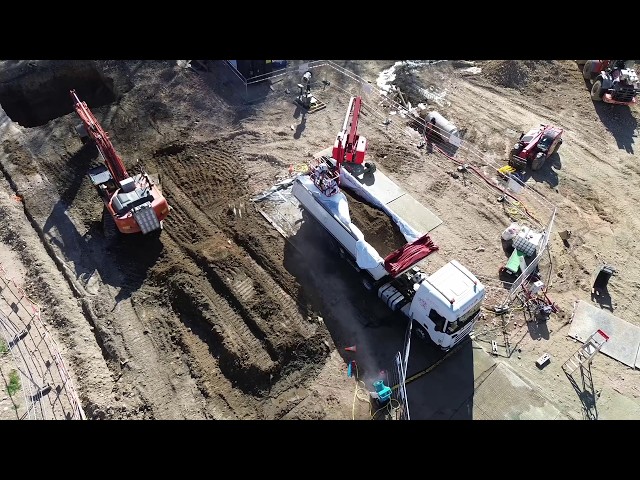
In fact, a stream ran alongside the site to the south. Protecting its flow and water quality quickly became a key issue: every earthwork operation had to be carefully planned to prevent any material or sludge from entering the watercourse. To the north, the nearby county road required constant vigilance to avoid disrupting traffic for local residents. The rugged topography of the site itself, with a steep east-west slope, complicated access for machinery and the installation of work platforms. Finally, the often unpredictable weather quickly turned the ground into mud, making the work even more difficult. Key figures for the project 15,000 tons of material processed (the equivalent of 500 to 600 trucks)
- 8,400 m² of surface area
- 1,344 tons of asbestos-containing materials removed
- 50 m of pile walls to stabilize the ground
Customized technical solutions
To overcome these difficulties, the project was organized in successive phases, each addressing specific constraints that had to be controlled.
- Preparing the ground
It was necessary to create a base camp and platforms to secure the movement of machinery and stabilize the site, which were essential steps before any further work could be carried out. - Stabilizing and protecting
A 50-meter-long wall of secant piles had to be built to limit underground runoff and ensure the stability of the soil before excavation. Along the stream, the teams even had to erect a wall made of concrete blocks to prevent material from falling and contaminating the water during the work. - Excavate and decontaminate
The earthworks required a rigorous three-phase organization. First in the open air, then under tents equipped with air extractors and breathing units to ensure the protection of operators, and finally outside the tents for materials containing asbestos. In total, the teams removed nearly 1,344 tons of asbestos-containing materials to specialized centers, strictly complying with "subsection 3" of the very specific regulations concerning asbestos. - Treatment and recovery
More than 15,000 tons of materials had to be sorted, recycled, or treated according to their level of contamination. Each treatment decision required a rigorous assessment guided by safety and environmental impact requirements. - Bringing the site back to life
The teams then proceeded to remodel and revegetate the land to complete the project. The goal was to recreate a natural slope and sow vegetation to restore a harmonious landscape and encourage the return of biodiversity.
Thermal treatment of contaminated soil: complementary expertise
The soil most heavily contaminated with volatile compounds could not be treated on site, so it was sent to a specialized site belonging to the Séché Environnement group: the Sovatrise platform. There, our teams were able to implement thermal desorption treatment. In practical terms, the materials are heated to a high temperature, the pollutants turn into gas, and are then captured and treated in specific units. Once cleaned up, the soil can finally be reused or sent to appropriate channels. On this site, nearly 5,000 tons of materials were thermally treated, significantly reducing their environmental impact.

Sustainable rehabilitation
Today, the site bears almost no traces of its industrial past. Where the old sludge tanks once stood, the land has been reshaped, the slopes smoothed, and the ground secured. The stream is now protected and can flow freely.
In a few months, vegetation will have completely taken over the site. The construction site will disappear behind a landscape that is once again in harmony with its surroundings. And this site, long constrained by its history, will once again be able to blend into its surroundings, without any risk to the environment or future uses.
Our solutions for rehabilitating polluted sites and soils
All solutions

Rehabilitation of polluted sites and soil
Deconstruction, asbestos removal and depollution

Rehabilitation of polluted sites and soil
Pyrotechnic remediation

Rehabilitation of polluted sites and soil

